Start with a few reliable tools, learn how they work, and skip the gimmicks.
You want a simple, honest Kitchen Gadgets Guide for Beginners that helps you cook better, faster, and safer. I’ve tested gear in tiny apartments and busy home kitchens, and I know what actually earns a spot in a drawer. This Kitchen Gadgets Guide for Beginners breaks down essentials, smart upgrades, budget picks, and care tips so you can cook with confidence and enjoy the process.
How to Choose Your First Tools
Before buying anything, think about what you cook most. This Kitchen Gadgets Guide for Beginners starts with purpose, not hype. Tools should solve a real problem, fit your space, and be easy to clean.
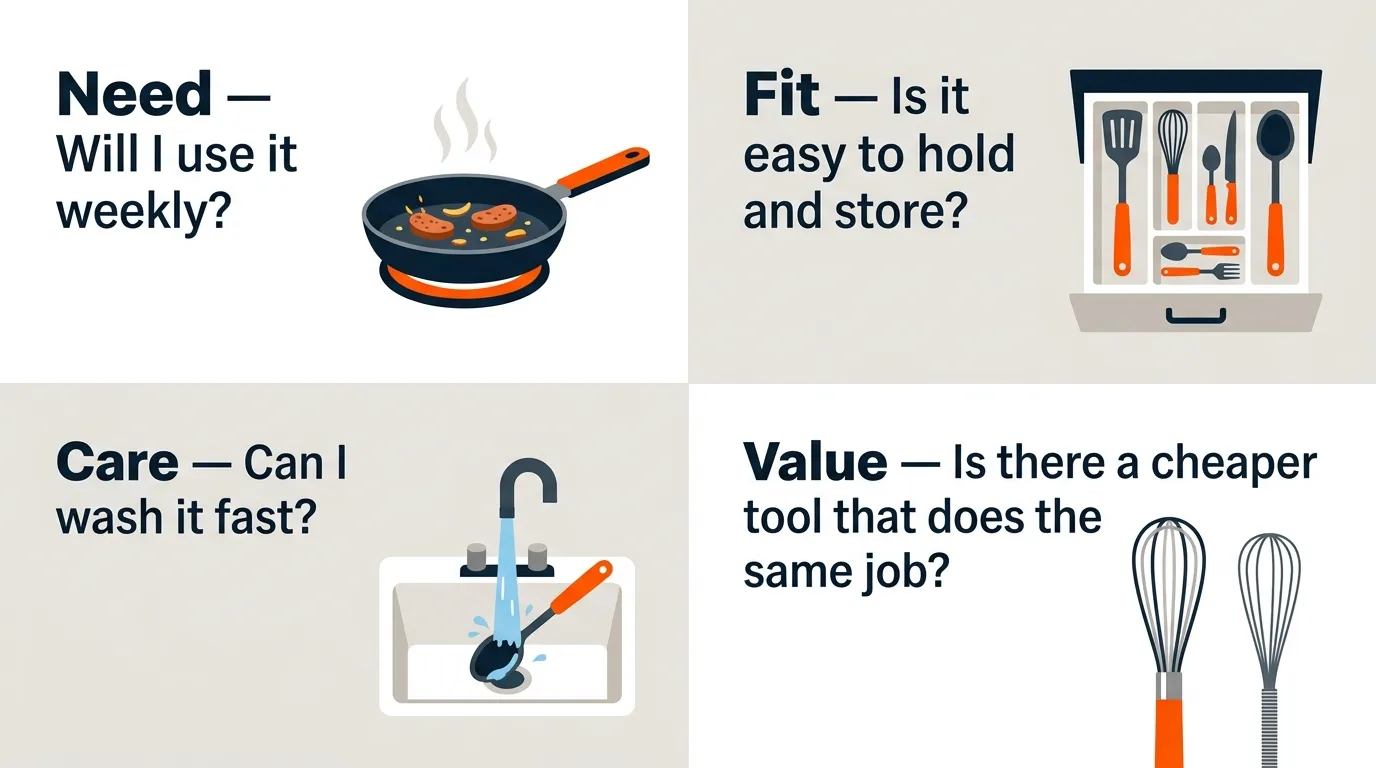
Use this quick filter:
- Need: Will I use it weekly?
- Fit: Is it easy to hold and store?
- Care: Can I wash it fast, with no fuss?
- Value: Is there a cheaper tool that does the same job?
Two rules I learned the hard way:
- One tool, many jobs beats single-use toys.
- Good basics save more time than fancy gadgets.
Essential Starter Gadgets: The 80/20 Toolkit

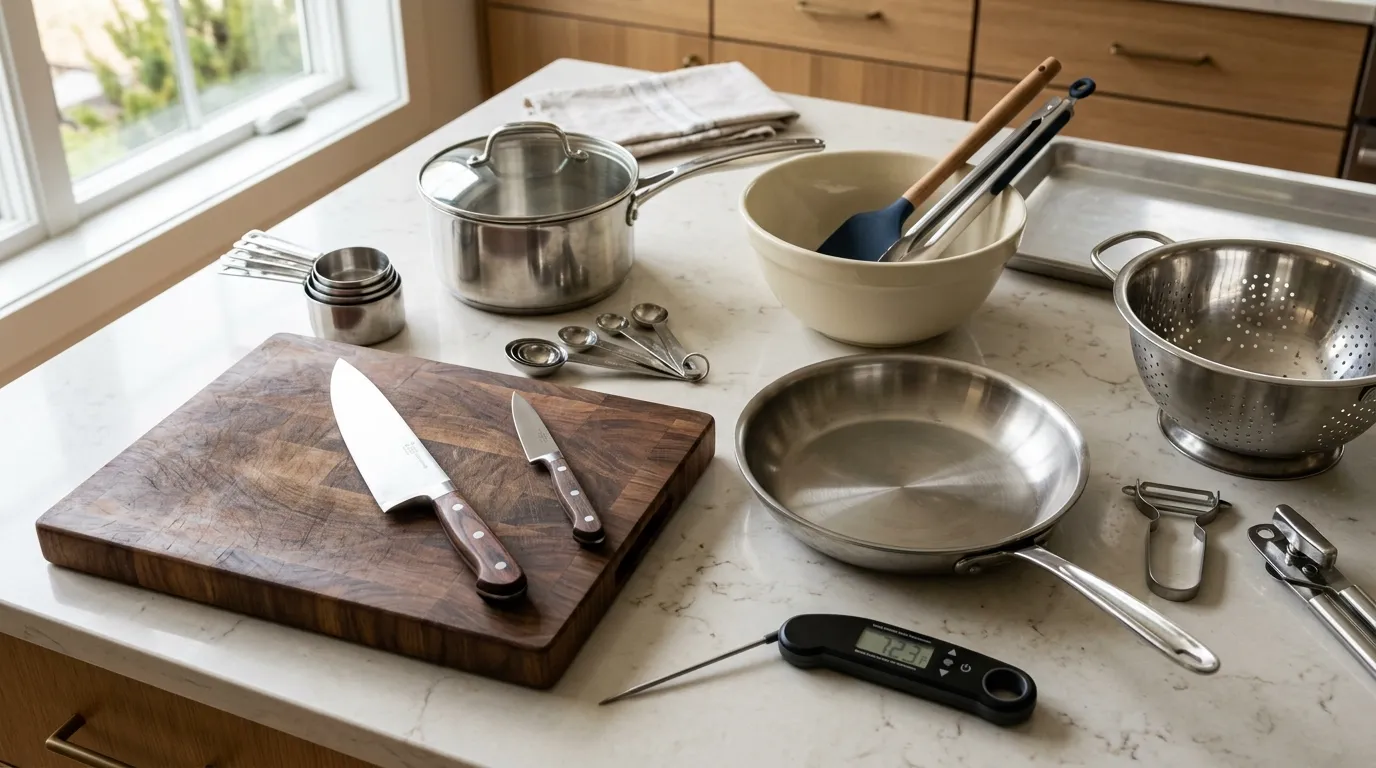
The Kitchen Gadgets Guide for Beginners should cover core items that do most of the work. These tools carry you through chopping, stirring, searing, baking, and safe temps.
Knives and cutting
- 8-inch chef’s knife: Stainless steel, comfy handle, balanced weight. Learn a safe pinch grip.
- Paring knife: For peeling, trimming, and small cuts.
- Cutting board: One large board with juice groove for meats, one small board for produce.
Measuring and mixing
- Measuring cups and spoons: Clear marks, sturdy metal or BPA-free plastic.
- Mixing bowls: Nesting set with non-slip base.
Heat and handling
- 10–12 inch skillet: Nonstick or stainless. Nonstick is easier for eggs; stainless sears better.
- Medium saucepan with lid: For grains, sauces, and reheating.
- Sheet pan: Rimmed, heavy gauge, for roasting and baking.
- Spatula and spoon: Silicone-safe for nonstick pans.
- Tongs: Locking, 9–12 inch, with good grip.
- Instant-read thermometer: Hits safe temps fast. Poultry at 165°F, leftovers at 165°F.
- Colander: For pasta, rinsing grains, and washing produce.
- Peeler: Y-peeler glides better.
- Can opener: Smooth-edge makes cleanup safer.
Real-life tip: I once cooked for weeks with one knife, one pan, and a bowl. It worked. But adding a thermometer and sheet pan doubled my speed and cut waste. That is the heart of a Kitchen Gadgets Guide for Beginners: fewer tools, better results.
Small Appliances Worth It for Beginners

Not every counter needs a gadget farm. This Kitchen Gadgets Guide for Beginners favors small appliances that earn their footprint.
Great first picks
- Blender: Smoothies, soups, sauces. A personal blender saves space and cleans fast.
- Hand mixer: Handles batters and whipped cream. Easier to store than a stand mixer.
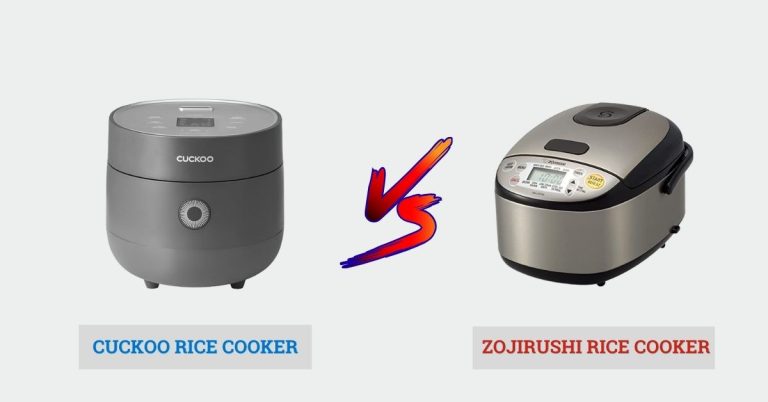
- Rice cooker: Set it and forget it. Keeps grains fluffy and frees a burner.
- Multi-cooker: Pressure cook, slow cook, sauté, and steam in one pot.
Maybe later
- Air fryer: A small convection oven. Great if you roast for one or two.
- Food processor: Big help for chopping and dough. Skip if your blender covers most jobs.
Limitations to know
- Nonstick baskets and pots can wear out. Avoid metal tools on them.
- Multi-cookers brown less than a skillet. Sear in the pot first to boost flavor.
Budgeting, Bundling, and What to Skip
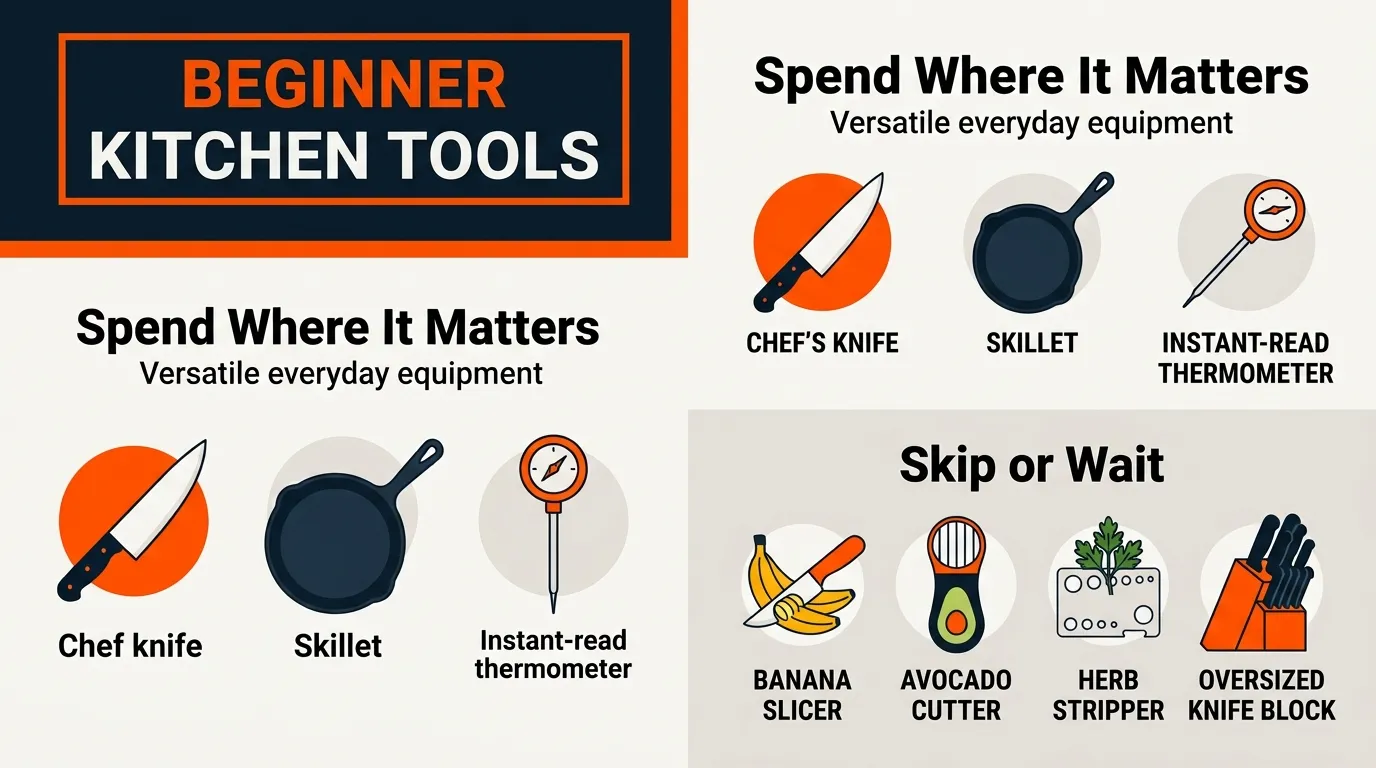
A Kitchen Gadgets Guide for Beginners should protect your wallet. Spend where it matters, save where you can.
Spend a bit more on
- Chef’s knife and skillet: You touch these every day.
- Instant-read thermometer: Reduces guesswork and food waste.
Save on
- Measuring sets, spatulas, and bowls: Mid-range works great.
- Colander and peeler: Simple, sturdy picks last years.
Skip or wait on
- Single-use tools like banana slicers, avocado cutters, or herb strippers.
- Ultra-cheap knife sets with 10 blades. One good knife beats a block of dull ones.
Buying tips
- Test handle comfort if you can. Tools should feel stable in your hand.
- Look for warranties and spare parts. That is a quiet sign of quality.
Safety, Care, and Storage
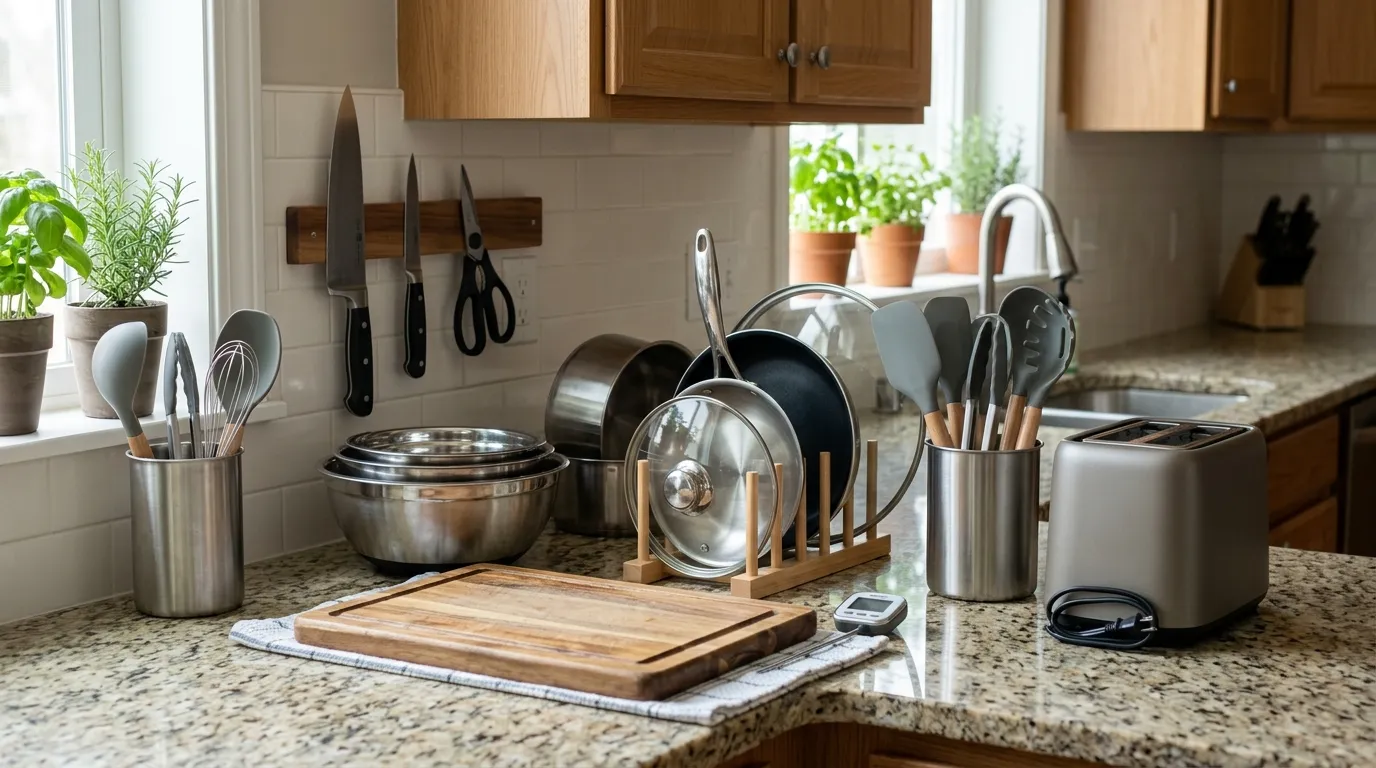
The Kitchen Gadgets Guide for Beginners is not complete without safety and care. Small habits prevent big problems.
Knife safety
- Keep knives sharp. Dull blades slip and cause cuts.
- Use a stable board and tuck your fingers.
Heat and hygiene
- Use the thermometer. Poultry and leftovers at 165°F, ground meats at 160°F.
- Cool leftovers fast in shallow containers.
Pan and appliance care
- Avoid metal tools on nonstick. Hand-wash nonstick to extend life.
- Unplug small appliances before cleaning. Keep cords dry.
Storage tips
- Use a drawer tray for knives or a magnetic strip.
- Nest bowls and pans. Store lids upright with a small rack.
Real-Life Starter Kits You Can Copy
Here are simple setups I’ve used in small homes. This Kitchen Gadgets Guide for Beginners favors kits you can build over time.
Bare bones, under $100
- Chef’s knife, paring knife
- Cutting board set
- Measuring cups and spoons
- Spatula, spoon, tongs
- Medium nonstick skillet
- Colander, peeler, can opener
Solid start, around $200
- Add instant-read thermometer
- Add saucepan with lid
- Add sheet pan and mixing bowls
- Upgrade to a better chef’s knife or a second skillet
Tiny kitchen, low storage
- 10-inch nonstick skillet with lid
- Personal blender
- Nesting bowls with lids
- Folding colander and compact tongs
- Magnetic strip for knives
Cooking Workflow: How Gadgets Save Time
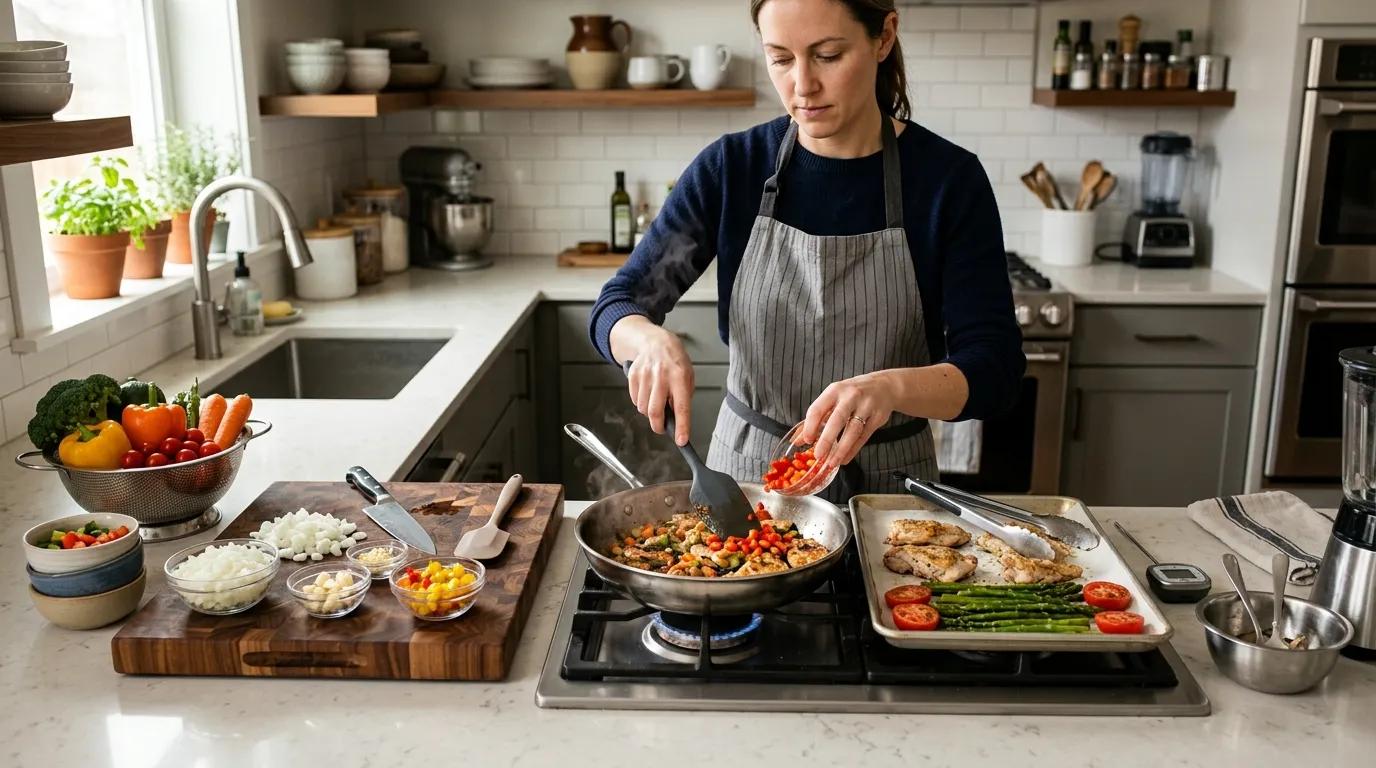
The Kitchen Gadgets Guide for Beginners is also about flow. A good flow cuts prep time and dishes.
Try this sequence
- Read the recipe once. Gather tools on the counter.
- Chop all produce first. Place in bowls by cook time.
- Preheat pan or oven early. Hot metal makes better browning.
- Clean as you go. Rinse tools right after use.
Time-savers I rely on
- Sheet pan suppers: Protein plus veggies at 425°F, finish in 20–30 minutes.
- Thermometer check: Pull meat at temp, rest a few minutes, serve juicy.
- Blender sauces: Toss herbs, oil, lemon, salt. Blend in 30 seconds.
Skill Builders: Learn Each Gadget Fast
A Kitchen Gadgets Guide for Beginners should teach skills, not just gear lists. Practice with short, repeatable tasks.
Knife and board
- Julienne a carrot, dice an onion, mince garlic. Time yourself for fun.
- Keep a damp towel under the board to stop slips.
Thermometer
- Take three readings in thick cuts. Aim for center mass.
Skillet
- Preheat 2–3 minutes. Add oil, then food. Listen for a gentle sizzle.
Blender or mixer
- Blend soups in batches. Vent steam with a towel to avoid splatter.
- Start low, then increase speed.
Oven and sheet pan
- Roast broccoli with oil and salt. Flip once. Finish with lemon.
Sustainable and Space-Smart Choices
Your Kitchen Gadgets Guide for Beginners can be green and tidy.
Do more with less
- Pick multi-use tools. A bench scraper moves chopped food and cleans the board.
- Use glass containers as bowls, storage, and bakeware.
Care that lasts
- Sharpen knives a few times a year. Hone often.
- Replace silicone tools when edges fray.
Cut waste
- Freeze herb stems for stock. Save bones for broth.
- Plan two meals per shop. Roast extra veggies for lunch bowls.
Frequently Asked Questions of Kitchen Gadgets Guide for Beginners
Do I need an expensive knife to start?
No. A mid-priced chef’s knife with a comfy handle is enough. Keep it sharp and it will outperform a pricey dull blade.
Is a multi-cooker better than a slow cooker?
It depends on your style. A multi-cooker does more in one pot, while a slow cooker is simple and cheaper.
What pan should I buy first?
Get a 10–12 inch nonstick or stainless skillet. Nonstick is easier for eggs, while stainless gives better browning.
How do I avoid gadget clutter?
Buy for weekly use, not one-time recipes. If a tool has one job, skip it until you feel the need.
Are thermometers really necessary?
Yes. They give safe, juicy results and prevent overcooking. Aim for 165°F for poultry and 160°F for ground meats.
Conclusion
Start simple, master the basics, and add gear with a purpose. This Kitchen Gadgets Guide for Beginners gives you a clear path: focus on a sharp knife, a solid pan, a thermometer, and a few helpers. Build skill, not clutter, and let your tools support your cooking, not control it.
Ready to kit out your kitchen? Pick one upgrade from this guide, try a new recipe this week, and share your wins. Want more tips? Subscribe for updates or leave a comment with your top beginner gadget.