
Microwave cooking is safe, fast, and easy when you master time, power, and tools.
You want to cook great food with less stress. This Microwave Cooking Guide for Beginners will show you how. I’ve taught many people to use a microwave like a pro, from dorm kitchens to busy homes. You’ll learn how it works, what to use, and how to cook real meals with trust and skill. Read on, and let this Microwave Cooking Guide for Beginners be your step-by-step coach.
How a Microwave Works

Microwaves heat food by exciting water molecules. A part called a magnetron makes the waves. The turntable spreads heat by moving food through hot and cool spots. That is why stirring and resting help.
Your door has a metal screen. It keeps the waves inside. The cavity reflects waves to the food. Most units run at one frequency. That is 2.45 GHz. It is strong for heating water, fat, and sugar.
This Microwave Cooking Guide for Beginners keeps science simple. When you know the basics, you can predict results. That means fewer cold centers and fewer dry edges.
Safety and Setup Basics

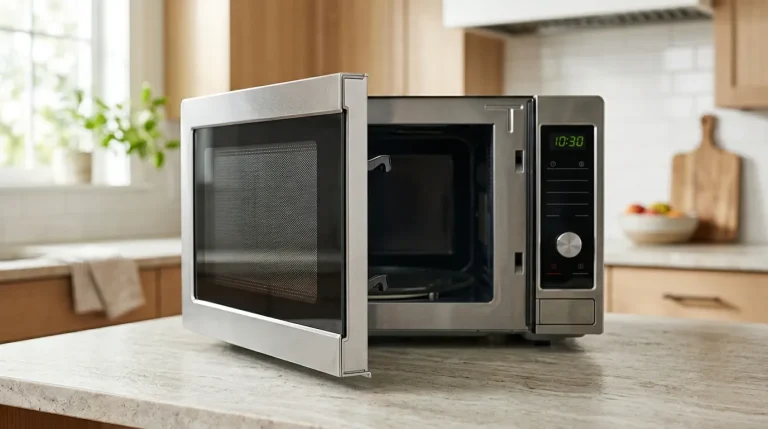
Place the unit on a stable, flat surface. Leave space around vents. Do not block the back or sides. Keep it dry and clean.
Check the wattage on the label inside the door. Most home models are between 700 and 1200 watts. Higher watts cook faster. This Microwave Cooking Guide for Beginners uses 1000 watts as a common base.
Use only microwave-safe glass, ceramic, and plastics with microwave-safe labels. Never use metal, closed jars, or twist ties. Avoid thin plastics that can warp.
Quick pre-use check:
- The turntable spins free and level.
- The door seal is clean and tight.
- No chipped plates or cracked bowls.
- A cup of water is inside if you run a short test.
Controls, Wattage, and Power Levels

Power levels control how often the magnetron runs. Power 10 is full power. Power 5 is about half. This cycling helps heat food more evenly.
Know your wattage. Time in a 700-watt unit takes longer than in a 1000-watt unit. To find your wattage, heat 1 cup of room temp water. If it boils in about 2 minutes, your unit is near 1000 watts. Slower boil means lower watts.
Simple time conversion:
- From 1000W to 700W: increase time by about 40%.
- From 1200W to 1000W: reduce time by about 15%.
- When unsure, start low and add 15–30 seconds.
In this Microwave Cooking Guide for Beginners, I suggest starting at 70–80% power for dense foods. It reduces hot spots and helps the center catch up.
Cookware, Covers, and Wraps
Choose glass or ceramic dishes without metallic trim. Thick glass heats gently. It resists stains. Use plastics only if they say microwave-safe.
Covering is key. A vented lid keeps steam in and splatter down. You can also use:
- A damp paper towel for reheating pizza or rice.
- Parchment for steaming fish or veg.
- A silicone lid with a small vent.
Do not seal food tight. Steam needs a way out. Small vents prevent bursting. For example, pierce potatoes and squash before cooking.
This Microwave Cooking Guide for Beginners teaches you to trap steam on purpose. It leads to juicy, even results.
Core Techniques for Beginners
Reheating Without Drying Out
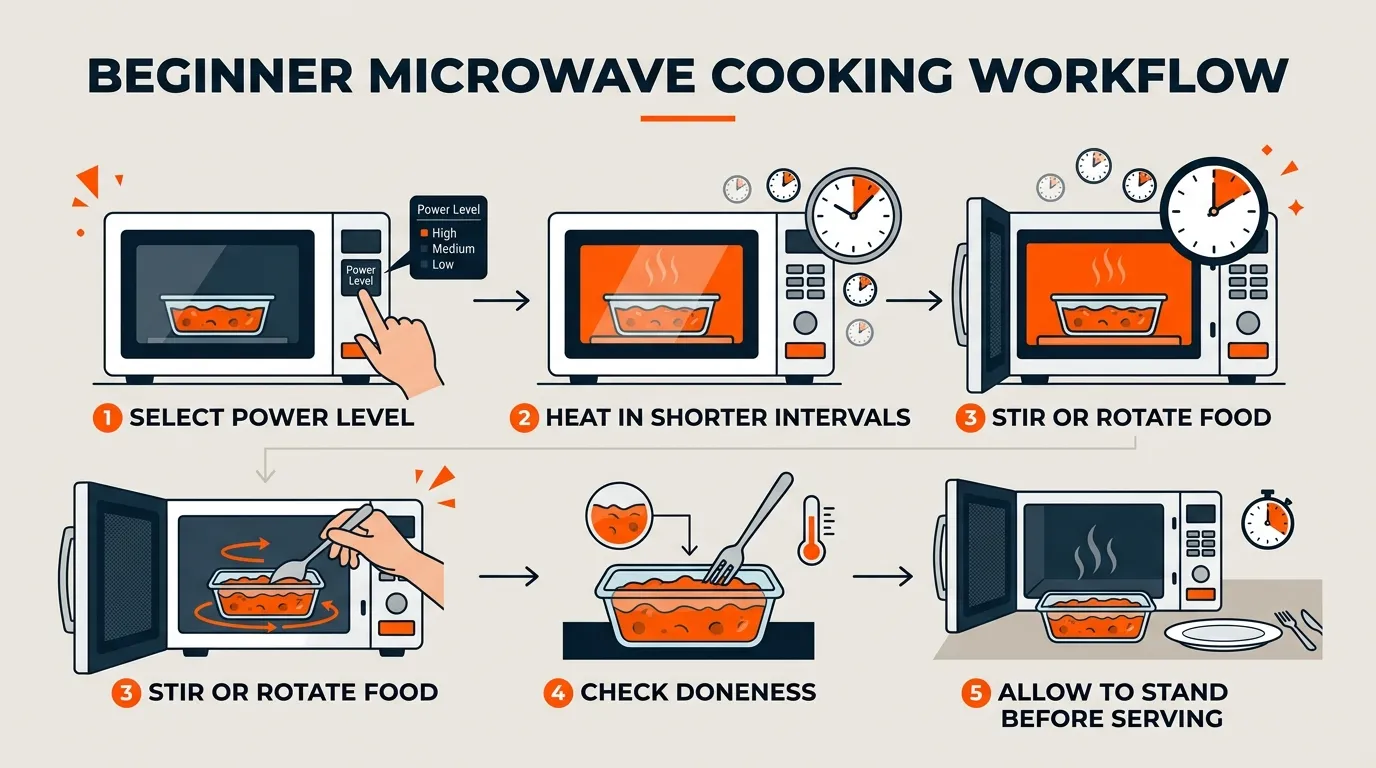
- Use 60–80% power.
- Break food into even pieces.
- Cover and vent.
- Stir or flip halfway.
- Rest 1–2 minutes to finish cooking.
Steaming Vegetables Fast
- Add 1–2 tablespoons of water to a bowl of cut veg.
- Cover and vent.
- Cook 2–4 minutes at full power for 1–2 cups.
- Season after cooking for bright flavor.
Poaching Eggs or Chicken
- For eggs: Crack into a mug of warm water. Prick the yolk with a toothpick. Cover. Cook 40–60 seconds at 50–60% power. Rest 30 seconds.
- For chicken: Place thin cutlets in a shallow dish with broth. Cover and cook at 60–70% power for 3–6 minutes, turning once. Rest 3 minutes. Check doneness.
Baking-Style Results in a Mug
- Use a microwave-safe mug. Fill it halfway to avoid spillovers.
- Cook on full power in short bursts.
- Let it rest. Heat keeps working after time ends.
I learned to lower power the hard way. My first dorm omelet turned rubbery. Now I cook eggs at 60% power and stir once. The texture stays tender. That is a core lesson in this Microwave Cooking Guide for Beginners.
Defrosting and Reheating Food Safely
Set the unit to Defrost or 30% power. Low power thaws ice without cooking edges. Separate pieces as they soften. Remove thawed parts and keep going with the rest.
Stir ground meat often during defrost. Flip fish once. Keep food cold to the touch. Finish cooking right after defrost. Do not leave it on the counter.
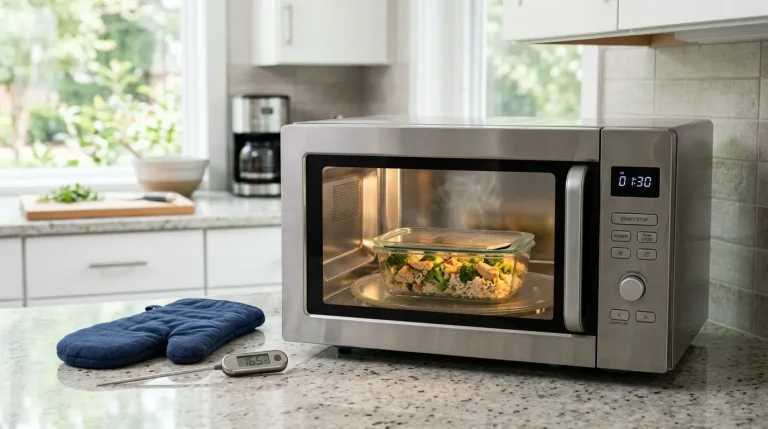
For leftovers, food safety guidelines suggest 165°F in the center. Use a food thermometer. Reheat soups and sauces until they bubble. Cover and let rest 1–2 minutes. This Microwave Cooking Guide for Beginners will remind you: time plus rest brings safe, even heat.
Quick Starter Recipes You Can Trust

These are my go-to wins from years of testing. Times are for 1000W. Add 20–40% for 700W.
Oatmeal for One
- Mix 1/2 cup rolled oats, 1 cup water or milk, pinch of salt.
- Cook 2 minutes. Stir. Cook 30–60 seconds more.
- Rest 1 minute. Add fruit, nuts, or honey.
Steamed Broccoli
- Add 2 cups florets and 2 tablespoons water to a bowl. Cover and vent.
- Cook 3–4 minutes. Rest 1 minute. Add butter, lemon, and salt.
Mug Omelet
- Beat 2 eggs with 1 tablespoon milk, salt, and cheese in a mug.
- Cook 45 seconds at 60–70% power. Stir. Cook 30–45 seconds more.
- Rest 30 seconds. Add herbs.
“Baked” Potato
- Scrub and pierce a medium potato 6–8 times.
- Cook 4–6 minutes, turning once.
- Rest 2 minutes. Split, fluff, and top.
Two-Minute Chocolate Mug Cake
- Mix 1/4 cup flour, 2 tablespoons sugar, 2 tablespoons cocoa, pinch of salt.
- Stir in 3 tablespoons milk, 2 tablespoons oil, splash of vanilla.
- Cook 60–90 seconds. Rest 1 minute. Add chocolate chips if you like.
This Microwave Cooking Guide for Beginners focuses on short, steady bursts. That is how you avoid dry edges and soggy centers.
Cleaning, Care, and Odor Control
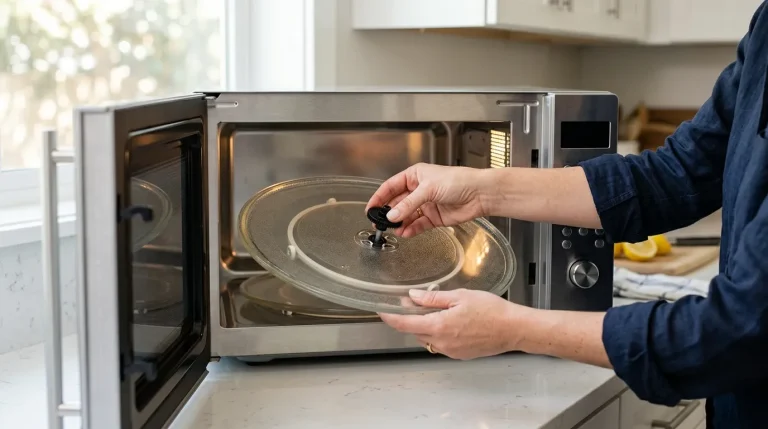
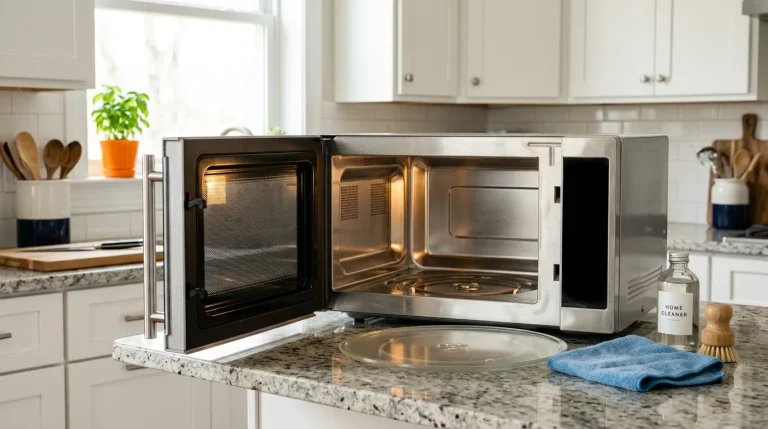
Wipe spills right away. Dried splatter blocks heat and smells bad. Remove the turntable. Wash it in warm, soapy water.
Steam-clean weekly. Heat 1 cup water with lemon slices for 3 minutes. Let it sit for 2 minutes. Wipe walls with a soft cloth. For odors, leave baking soda inside overnight.
Keep vents clear. If a light bulb or turntable breaks, unplug before checking. This Microwave Cooking Guide for Beginners treats care as part of safe cooking.
Troubleshooting and Common Mistakes

Food is hot outside, cold inside
- Lower power to 60–80%.
- Stir halfway. Rest 1–2 minutes.
Rubbery eggs or tough chicken
- Cook at lower power for longer.
- Cover and vent. Let it rest.
Sauce boil-overs
- Use a larger bowl. Stir often.
- Place a chopstick in the bowl to break bubbles.
Exploding foods
- Pierce skins on potatoes, sausages, or tomatoes.
- Vent covers. Do not seal.
Metal sparks
- Remove foil, metal trim, and twist ties.
- If sparking starts, stop at once and remove the item.
I once superheated water in a clean mug. It burst when I moved it. Now I put a wooden stir stick in the cup. This small trick prevents sudden boiling. This Microwave Cooking Guide for Beginners includes these real-life fixes so you stay safe.
Nutrition, Myths, and Benefits
Microwave cooking does not “nuke” nutrients. It can keep more vitamins than boiling. Short times and less water protect vitamin C and B vitamins. That is a big plus for vegetables.
Benefits you can count on:
- Less time and energy use.
- Fewer dishes and cleanup.
- Great for small portions.
- Gentle on delicate foods at lower power.
Limits to note:
- Browning is light without a crisping tray.
- Large roasts cook unevenly.
- Some plastics are not safe. Always check labels.
Food science data supports these points. Still, results vary by wattage and food size. This Microwave Cooking Guide for Beginners helps you balance speed and quality for daily meals.
Time and Power Cheat Sheet
Use this quick guide to adjust on the fly:
- If a recipe says 4 minutes at 1000W, cook 5:30–6:00 at 700W.
- If your unit is 1200W, cook 3:20–3:30 instead of 4:00.
- Dense foods like potatoes, squash, or meat need lower power and longer time.
- Thin or moist foods like soup or veg do well at full power in short bursts.
- Always add 1–2 minutes of rest for carryover heat.
This Microwave Cooking Guide for Beginners favors small steps. Add 15–30 seconds at a time. Stop when the center is hot and the texture looks right.
Frequently Asked Questions of Microwave Cooking Guide for Beginners
How do I know if a container is microwave-safe?
Look for a microwave-safe label on the bottom. If unsure, heat it empty with a cup of water for 60 seconds. If the dish stays cool and the water heats, it is likely safe.
Is it safe to microwave frozen meat?
Yes, if you use defrost power and cook it right after thawing. Keep edges from cooking by separating pieces and turning often.
Why does my microwave heat unevenly?
Microwaves create hot and cool spots. Use a turntable, cover food, lower power, and stir or rotate halfway for even heat.
Can I microwave food in foil?
Avoid foil unless the manual says small, smooth pieces are okay. Never let foil touch the walls, and do not cover food fully.
Do microwaves destroy nutrients?
No. Short cook times and less water can protect vitamins better than boiling. Steaming veggies in the microwave is very nutrient-friendly.
What is the best power level for reheating leftovers?
Use 60–80% power to prevent dry edges and cold centers. Cover and rest for 1–2 minutes before serving.
How can I stop pasta or sauce from splattering?
Use a larger bowl, cover with a vented lid, and stir every 30–45 seconds. Lower power helps control bubbling.
Is it okay to run a microwave empty?
No. Running it empty can damage the magnetron. Always have food or a cup of water inside when testing.
How do I reheat pizza so it stays crisp?
Place a paper towel under the slice and use 50–60% power in short bursts. Or use a microwave-crisping tray for better crust.
What temperature should leftovers reach?
Aim for 165°F in the center for safety. Stir, check with a thermometer, and let the food rest to even out the heat.
Conclusion
You now have the key skills to cook fast, safe, and tasty meals. This Microwave Cooking Guide for Beginners showed you how to use power levels, the right tools, smart covers, and simple steps. You learned safe thawing, quick recipes, and fixes for common problems.
Start with one new tip today. Try a mug omelet at 60% power or steam some broccoli. Share your wins, ask questions, and keep learning. Want more easy kitchen skills? Subscribe, leave a comment, or bookmark this guide for your next meal.